
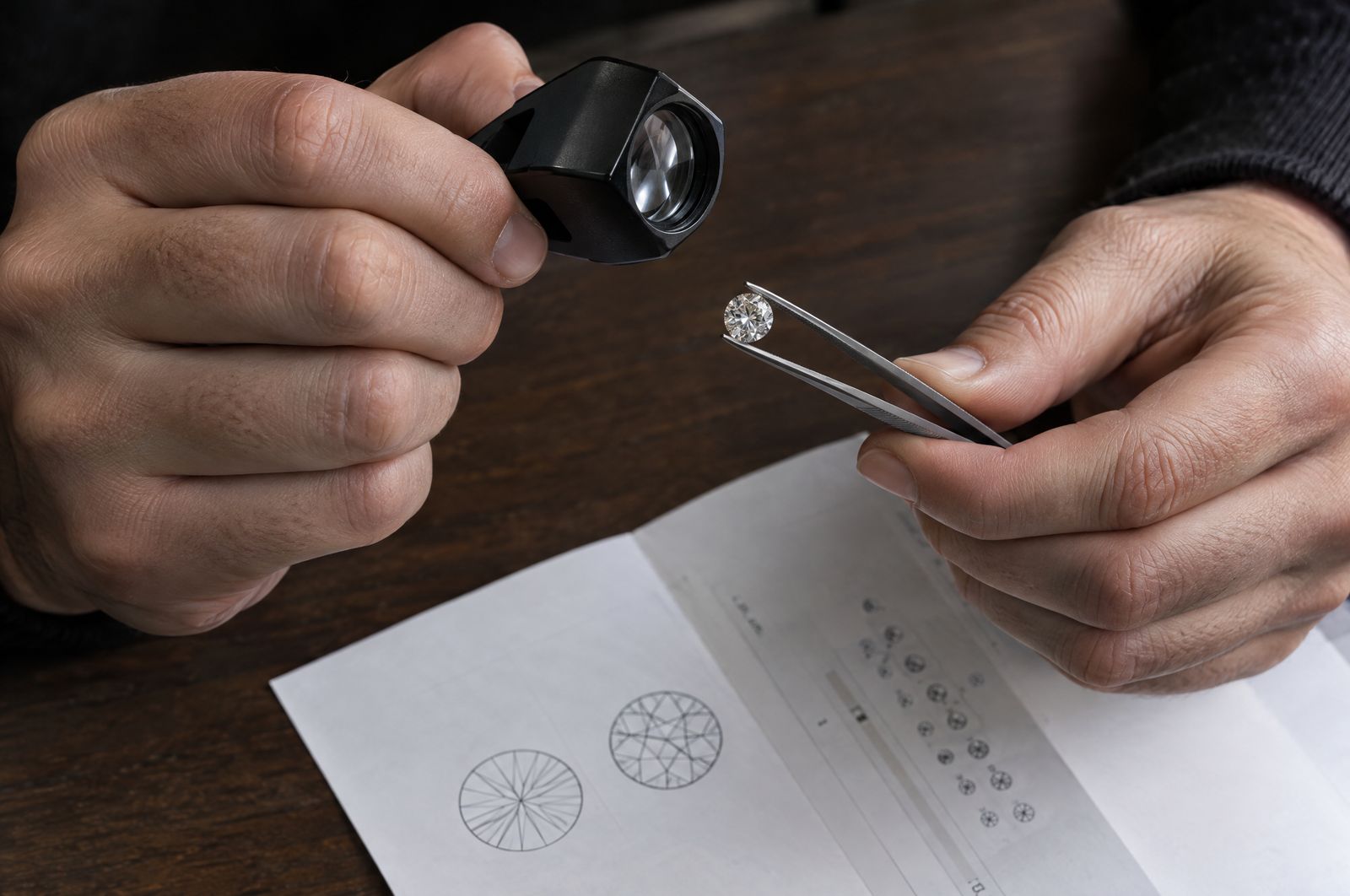
Every diamond engagement ring sold in Denver, from a downtown showroom to an online listing shipped to a Highlands apartment, is described with the same four words: cut, color, clarity and carat. This Denver diamond 4Cs guide explains what each grade actually measures, which one deserves your money first, and how to check the grading report so the stone in the box matches the stone on paper.
A quick warning before the details. The 4Cs describe a diamond; they do not describe a ring. Two stones with identical grades can look different on a hand, and a well-chosen setting can make a modest stone look generous. Use the grades to narrow the field, then use your eyes.
Cut decides how the diamond performs
Cut is the only one of the four that people shape. Nature sets the color and the inclusions; a cutter decides the angles, the proportions and the finish. Those decisions control how much light enters the stone, bounces between the pavilion facets and comes back out through the top.
For round brilliant diamonds, GIA assigns a cut grade from Excellent down to Poor. Some laboratories, IGI among them, also use an Ideal grade at the top of their scale. The grade blends brightness (white light returned), fire (flashes of color) and scintillation (the sparkle pattern when the stone or the viewer moves), along with polish and symmetry.
Why cut comes first
A poorly cut stone leaks light. It can look glassy or dark in the center even with top color and clarity. A stone cut too deep also hides its weight underneath, so you pay for carats you cannot see from above. If you remember one rule from this page, make it this one: secure an Excellent or Ideal cut on a round diamond before spending on anything else.
Ovals, pears, emeralds, cushions and other non-round shapes usually do not receive an overall cut grade on a GIA report. You get polish and symmetry grades plus the measurements. That makes your own eyes, or detailed video, more important. Look for a dark "bow tie" across the middle of ovals, pears and marquises; some is normal, a heavy one is not.
Color is about the absence of color
For white diamonds, the color grade measures how much yellow or brown tint a stone shows when it is viewed face-down against white under controlled light. The GIA scale runs from D (colorless) to Z (light yellow or brown).
| Grades | Category | What it usually means in a ring |
|---|---|---|
| D, E, F | Colorless | No visible tint. Pays for a difference most people cannot see once the stone is set. |
| G, H, I, J | Near colorless | The common value zone. G and H tend to face up white in platinum or white gold. |
| K, L, M | Faint | A warm tint some people like, especially set in yellow or rose gold. |
| N to Z | Very light to light | Visible color. Rare in engagement rings unless the warmth is the point. |
Metal changes the picture. Yellow gold reflects warmth into the stone, which hides a little tint, so an I or J can look right in a yellow gold solitaire. A bright platinum setting does the opposite and makes slight warmth easier to spot.
Fluorescence is the other color note on a report: how the diamond glows under ultraviolet light, graded from None to Very Strong. Most of the time it has no visible effect in daylight. Occasionally strong fluorescence makes a stone look slightly hazy. If a report lists Strong or Very Strong, ask to see the diamond in daylight before deciding.
Clarity is graded under magnification, worn without it
Clarity grades describe internal features (inclusions) and surface marks (blemishes) seen under 10x magnification by a trained grader. The GIA scale has eleven grades: Flawless, Internally Flawless, VVS1, VVS2, VS1, VS2, SI1, SI2, I1, I2 and I3.
Here is the practical part. Nobody wears a loupe. What matters is whether the stone looks clean to the naked eye at a normal viewing distance, a quality the trade calls "eye clean." Many VS2 and SI1 diamonds are eye clean. Some SI1 stones are not, because a dark crystal sits right under the table. The grade gives a range; the inclusion map on the report and a close look at the stone tell you where in that range this particular diamond falls.
Where inclusions sit matters
A small feather near the girdle, hidden by a prong, is cosmetic. A feather that reaches the surface near a corner on a princess or a pear tip can become a durability question, because points and corners take knocks. Ask the seller to show you each plotted feature in the actual stone.
Carat is weight, and price steps at round numbers
One carat equals 0.2 grams, and a carat divides into 100 points, so a 0.75 carat diamond is "seventy-five points." Carat is weight, not size. A stone cut shallow spreads its weight across a wider face; a stone cut deep carries weight below the girdle where nobody sees it.
Prices tend to jump at popular weights such as half a carat and one carat. A 0.90 carat stone and a 1.00 carat stone of the same grades differ by only about 3.5 percent in diameter, all else equal, which is hard to see on a hand, yet the price per carat often changes noticeably at the threshold. Buying just under a round number is one of the simplest legitimate savings in this market.
Read the millimeters, not just the carats. The face-up diameter is what people see across the table.
How to read a diamond grading report
A grading report is an independent laboratory's description of one stone. GIA and IGI are the two names Denver buyers see most often; you may also meet reports from other labs. Each report carries a unique number. Many diamonds also carry that number as a microscopic laser inscription on the girdle.
The report is only useful if it belongs to the stone in front of you. Before you go further with any ring, do three things: look up the report number on the laboratory's own website (not a link the seller sends), match the printed measurements and weight to the stone, and ask to see the girdle inscription through a loupe or microscope.
Laboratories label lab-grown diamonds clearly, and some report them differently from natural stones. GIA announced in 2025 that its lab-grown reports would move away from the full color and clarity scales toward broader descriptions. Check the current format of any report you are handed, and do not assume two reports are directly comparable.
Compare stones graded by the same laboratory where you can. Grading involves trained human judgment within published standards, and buyers in the trade often treat grades from different labs as not quite interchangeable. That is not an accusation against any lab; it is a reason to compare like with like. Our lab-grown vs natural guide covers how this plays out for lab-grown stones in particular.
Trading the grades against a budget
Once cut is secured, the other three grades are a balancing act. The matrix below is a starting framework, not a rule book.
Then turn the grades into a number you can live with. The budget and insurance guide explains how to set that ceiling before the first showroom visit, and the settings and metals guide shows how the mounting changes what the stone looks like.