
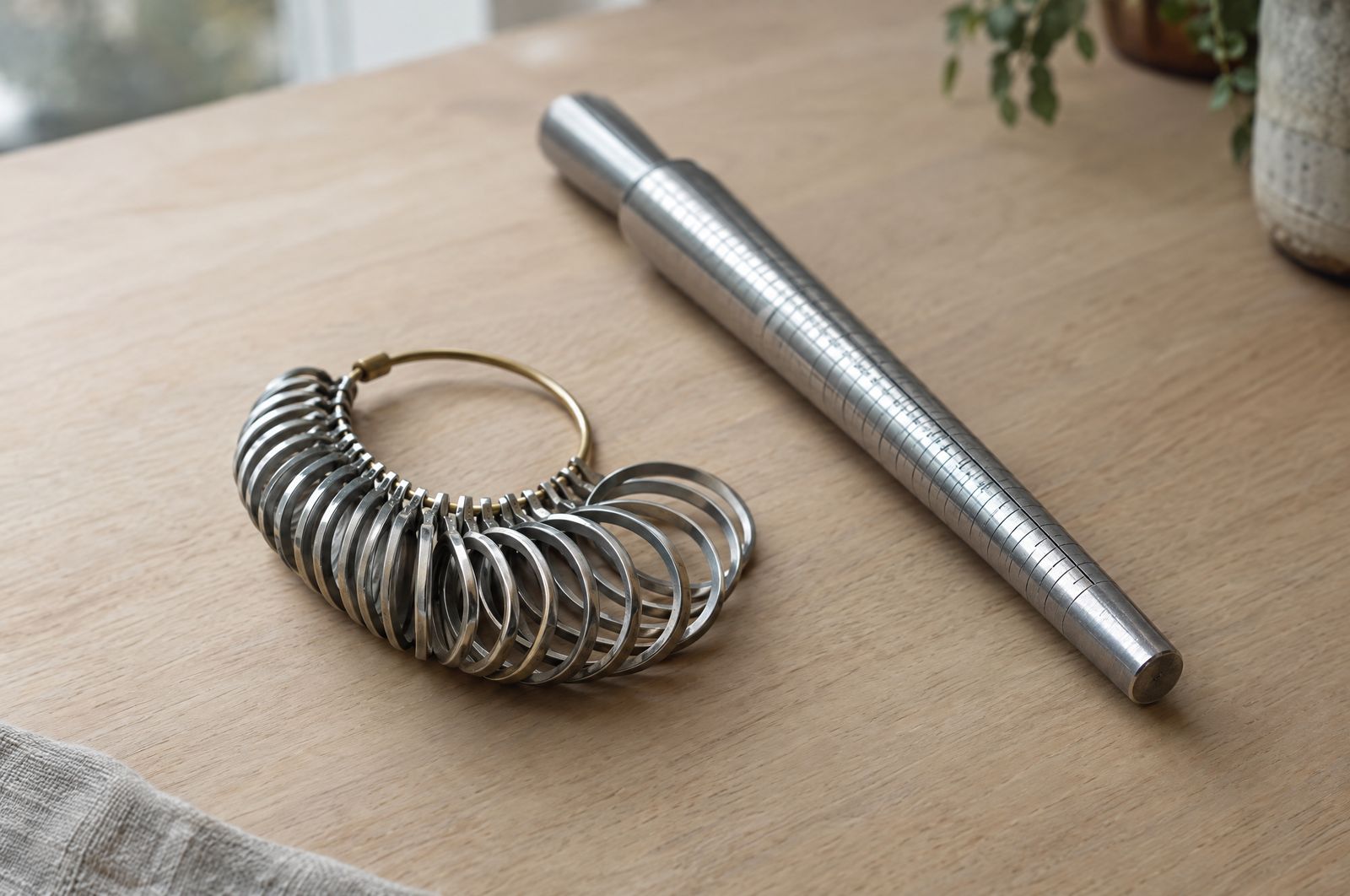
A ring that spins, pinches or will not pass the knuckle takes the shine off the moment fast. Ring sizing is the least glamorous part of buying an engagement ring and one of the easiest to get right with a little planning. This Denver ring sizing guide covers the quiet ways to learn a size, a converter for measurements, and the fit details that change the answer.
Quiet ways to find a ring size
You have more options than asking outright. Ranked from most to least reliable:
- Borrow a ring from the correct finger. Ideally one worn on the left ring finger, or the same finger on the right hand (which may run slightly larger on a dominant hand). A jeweler can size it on a mandrel in seconds. If you cannot take it out of the house, measure its inside diameter with a ruler or calipers, or press it into a bar of soap for an impression.
- Ask a close friend or family member to find out, or to take the wearer shopping for a "fun" ring.
- Trace the inside of a ring on paper with a sharp pencil, both edges, so you can measure the inner circle.
- Use the photo method: photograph a borrowed ring next to a ruler, straight on, and measure the inside diameter from the image.
Ring sizes come from the inside diameter or circumference. Measuring across the outside of the band adds the metal thickness twice and can push you a full size or more too large.
Ring size converter
US and Canadian sizes follow a standard scale where each whole size adds about 0.81 mm to the inside diameter. Use the converter with a diameter, a circumference or a US size. Treat the result as a strong estimate and confirm with a jeweler's gauge when you can.
Outside North America you will see other systems: UK and Australian sizes use letters, while many European sizes are given as the inside circumference in millimeters. The circumference figure above maps directly to that style.
Fingers change size, especially here
Fingers are not fixed. They tend to shrink in cold air and swell with heat, exercise, salty food, alcohol and, for some people, time at high elevation. In Colorado that means the same finger can read differently on a January morning walk to the car and on a warm July evening.
- Measure at room temperature, later in the day, when fingers are at their typical largest.
- Avoid measuring right after a run, a hot shower or a ski day.
- Check the ring passes the knuckle. If the knuckle is much larger than the base of the finger, ask about sizing beads or a contoured inner band.
A ring that slides off a cold finger on a chairlift is a ring you may not see again. Snug at room temperature is right.
Fit, band width and comfort
The right size should slide on with slight resistance at the knuckle and come off with a little twist. Width changes the feel. A wide band contacts more skin and tends to feel tighter, so many jewelers suggest a quarter to a half size larger for wide styles. A comfort-fit band, rounded on the inside, often feels looser than a flat inside band of the same size.
Top-heavy settings with a large center stone can rotate on the finger if the fit is loose. A slightly snugger fit, or a band with a squared profile, helps keep the stone upright.
When the size is wrong: resizing
Most plain gold and platinum bands can be resized up or down by about one or two sizes by a bench jeweler. Some designs resist it:
| Design | Resizing outlook |
|---|---|
| Plain solitaire band | Usually straightforward within a size or two |
| Pave or channel band | Possible but more involved; stones near the cut can loosen |
| Full eternity band | Usually cannot be resized; must be remade |
| Tension setting | Often cannot be resized without remaking |
| Titanium, tungsten, ceramic | Generally cannot be resized |
Before buying, ask whether the first resize is included and how long it takes. Those terms vary by seller and should be in writing. Then read the settings and metals guide so the design you choose leaves room for adjustment, and plan the moment itself with our Denver proposal ideas.