
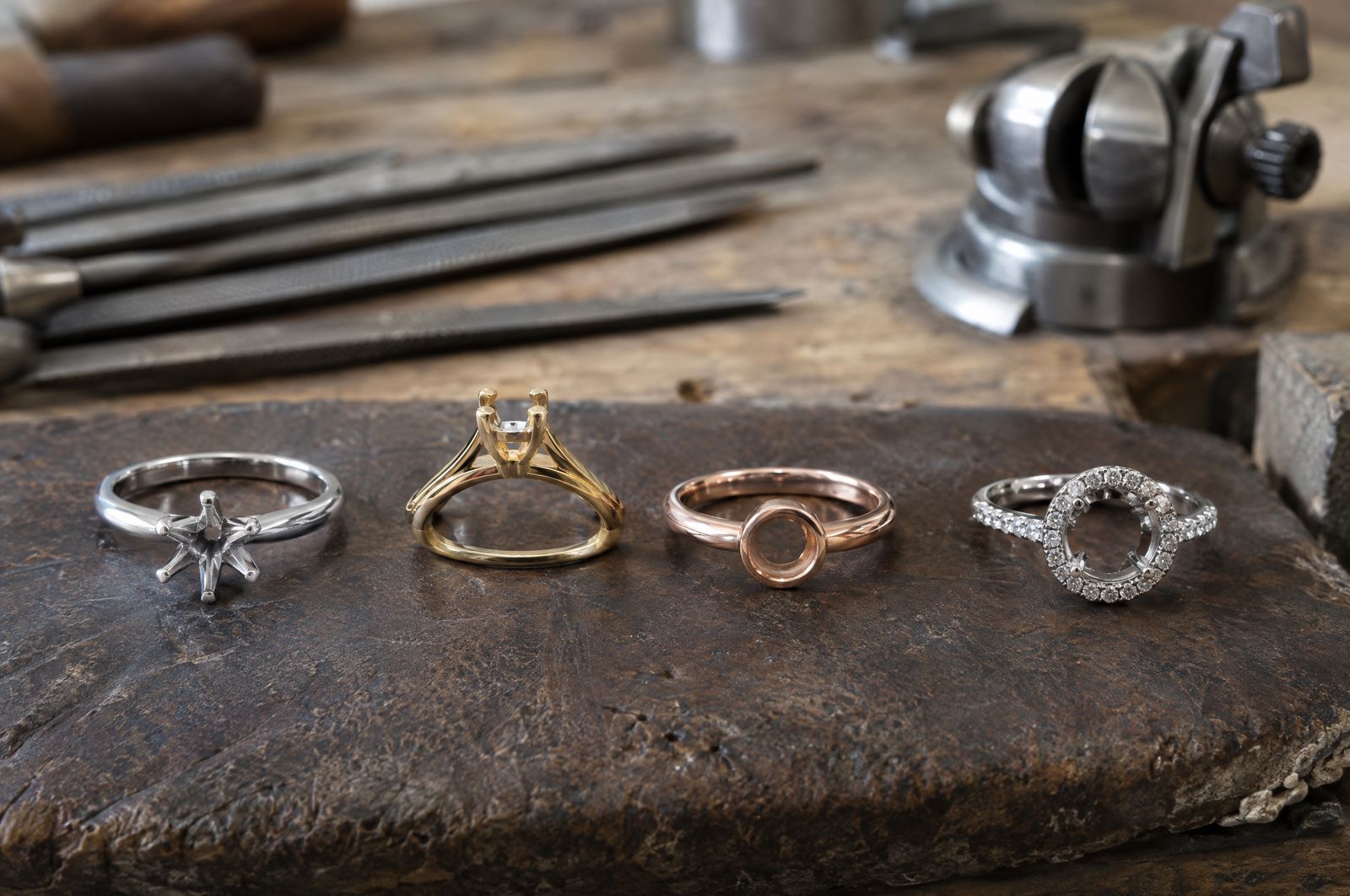
Most ring shopping starts with the stone and treats the setting as decoration. That gets the order of risk backwards. Ring settings and metals determine whether the center stone stays put, whether it snags a sweater, and whether the ring still looks right in ten years. This guide walks through the common styles and metals in the order you will meet them in a Denver showroom or a custom-design conversation.
Setting styles, from simplest to most intricate
Prong solitaire
Metal claws grip the stone and lift it toward the light. Four prongs show more of the diamond and give round stones a slightly squarer outline; six prongs are more secure and keep the stone held if one prong is bent. Pears, marquises and princess cuts should have a V-shaped prong guarding each point, because points are where those shapes chip.
Bezel
A continuous metal rim wraps the stone's edge. Bezels are the most protective common setting, a strong match for nurses, climbers, anyone working with their hands, and softer gemstones. The trade-off is slightly less light entering from the sides and a more modern look.
Halo
A ring of small diamonds around the center stone. It makes the center look larger and adds sparkle at a lower cost than a bigger stone. The small stones need periodic checks.
Pave and micro-pave bands
Rows of small stones set into the band and held by tiny beads of metal. Pave catches a lot of light. It also makes resizing more involved and can lose a stone after years of hard contact.
Three-stone and side-stone
A center stone flanked by two smaller ones, or by tapered baguettes. Good for spreading budget across several stones and for wearers who prefer width.
Cathedral and hidden halo
Cathedral settings sweep arches of metal up to the head; hidden halos tuck a row of small stones under the center where they show from the side. Both are design details more than structural choices, but both raise the stone's height.
Profile and height: the question nobody asks
How high the stone sits above the finger changes daily life more than most people expect. A tall setting shows off the stone and lets light in. It also catches on knit gloves, hair, pockets and backpack straps, and takes the hit when a hand meets a door frame. A low profile is calmer and more protective.
If a wedding band will be worn next to the engagement ring, ask now whether a band can sit flush against this setting. A low setting or a curved band may be needed. The band is a separate decision for later; for now, just make sure the engagement ring does not rule out the band you will want.
Engagement ring metals compared
| Metal | Color and look | How it wears | Worth knowing |
|---|---|---|---|
| Platinum | Naturally white, slightly gray | Dense and heavy; scratches mostly move metal instead of removing it, forming a soft patina | Usually about 95 percent pure. Can be polished back to a high shine. |
| White gold | Bright white when rhodium plated | Plating wears and needs renewing; alloy beneath is slightly warm | Some alloys contain nickel; ask about palladium white gold for sensitive skin. |
| Yellow gold | Warm, classic | Shows scratches as soft wear; easy to polish | Flatters warmer diamond colors and many colored stones. |
| Rose gold | Pink from copper in the alloy | Similar to yellow gold; color does not plate off | Copper content can bother some sensitive skin. |
| Palladium | White, lighter weight | Naturally white, no plating | Fewer jewelers work with it; ask about repair and sizing. |
A practical point: prongs can be a different metal from the band. Many yellow gold rings use white metal prongs so a near-colorless diamond does not pick up yellow reflections. That small detail is worth asking for.
14k vs 18k gold
Karat measures gold content: 24k is pure gold, 18k is 75 percent gold and 14k is about 58.3 percent. The rest is alloy metal that changes color and hardness. 18k has richer color and costs more. 14k generally holds up better to scratching and bending because of its higher alloy content, which is why it is a common choice for rings worn every day. Neither is wrong; it is a trade between color and wear.
The setting is the stone's insurance policy. Pick it for the wearer's worst day, not the photo.
Care and checks that keep a setting sound
- Have prongs and small stones checked by a jeweler once or twice a year. Worn prong tips are cheap to rebuild before a stone falls out, not after.
- Take the ring off for heavy lifting, climbing, gardening and chlorine pools.
- Clean at home with warm water, mild dish soap and a soft brush. Ask before using an ultrasonic cleaner, especially with emeralds or other treated stones.
- Store it separately so a diamond does not scratch other jewelry.
Pair this with the gemstone durability guide if the center stone is colored, and with the ring sizing guide before you order, since some settings are hard to resize later.